Saturday, March 26, 2011

Rollin' Along

Like many of us on this blue and white marble of a planet I wonder lately what in the heck we’re doing. We’re allowing guns in crowded public places, including those that serve alcohol; we’re bombing another Muslim country; we’re worrying again about run-away radiation and the price of oil. Some days it feels like we’re hell-bent on ridding the planet of our wacky selves.

And then I hear sparrows having an early happy hour in the holly bushes outside, watch a teenage boy walking the family dog through the park, and kick a soccer-sized ball, to my dog, Maisie’s, barking delight. There’s still a place for sanity in this world, for petting cats, observing migrating birds rest in our parks, and enjoying the vernal evening choirs of peepers.

Connecting with the non-shooting, non-bombing species helps keep us sane, and if pets help us be centered and more at peace, then bless us for having them. But keeping animals has become another Humongous Industrial Complex – a $41 billion dollar a year business is no joke*. So today I want to give a shout-out to Petco. I just went there to stock up on food and toothpaste for guess-who and they have signs- big and frequent signs – encouraging patrons to adopt pets, which is so great!

Now I know they’re not being altruistic – pets have to eat, brush their teeth, and wear funny clothes wherever they’ve come from. I doubt that sales of hamsters and parakeets is where Petco makes its profits, but still... It’s an important reminder that a lot of animals are abandoned or surrendered by their owners and they need homes. So “Hooray!” for Petco for helping raise awareness of a real need – our local ASPCA will accept and hopefully find homes for 6,000 cats this year. Six thousand, just in this area alone!

So here’s another big “Hooray!” for the Societies for the Prevention of Cruelty to Animals and Humane Societies, that strive to put themselves out of business. I think that’s a very cool goal, to end cruelty to animals, don’t you?

Now if only human animals were seriously part of such a mission, what a wonderful world it would be.

*Interesting fact: the proposed U.S. military budget for 2012 is $553 billion, down $43 billion from this year’s request.

Tuesday, March 15, 2011

Forget Miss Kitty


Okay, I confess I was all cranked up to write about these two little ginger kittens, to go for the easy awww - who doesn’t love the little dickens? They tumble, chase and pounce and – oh God - when they first learn to purr!

Luckily I had a long drive home two Sundays ago, because our local public radio station interviewed Derek and Beverly Joubert who reported things that shook me out of my Pretty Kitty bubble– they film lions and have fallen in love with them. Which is tragic because within about fifteen years, unless things (ie. we the people) change a lot, we’ll inhabit a world without any. In other words, we will be the cause of their extinction somewhere in the neighborhood of 2026. I take that back – there might be a few still in zoos, but that too-small gene pool will peter out before long.

How is this happening? You know...planters poach their ranges, which cats need for hunting and for maintaining a healthy gene pool. And we have for centuries killed them in large numbers, chiefly for sport or for medicinal purposes (a bag of lion bones goes for big, big money in parts of Asia), and sometimes to protect livestock or human beings.

Did you know there are already more tigers in captivity than in the wild? I didn’t. All of the big predator cats, including leopards, cheetahs, and jaguars, are in danger. This reality seems so unstoppable and sad. Beyond sad –I feel that we’re on the verge of doing something that can’t be undone ever. Something that diminishes our lives and our planet’s being. Just knowing that such a beautiful creature as the lion roams the savannahs wakes us to wonder, to marvel at the delight and mystery of being alive. So if they are gone, we become less delighted, less enfolded in mystery and wonder- less alive.

I do appreciate that we have much to feel responsible for and sad about – the victims of earthquakes in so many countries, and the battles raging in too many countries, and the drought and famine that threaten so many. Human ingenuity and compassion could mitigate many disasters, but not one of our failures to do so threatens our own species to the degree that we have threatened others. That’s the problem, I think: our disregard for the survival of other animals, lives over which we now have near total control.

So what to do... I’ve been working on to making changes in how I live that I hope will lessen the pressure on those places wild animals need to survive. coffee, tea, beef, and oil are a few of the things I like to consume that take a huge hunk out of their habitat. I try to consume less, and pay a fairer price for more sustainably grown foods. I support only politicians who are for sustaining this delightful, mysterious world of ours.

It’s helped me to at least make a start. How about you? I’d like to know what your thoughts are about this issue. I’m looking for ways, corny, I admit it- to save what is left of the world we were born of and into, the world that has made us who we are, for better and for worse.

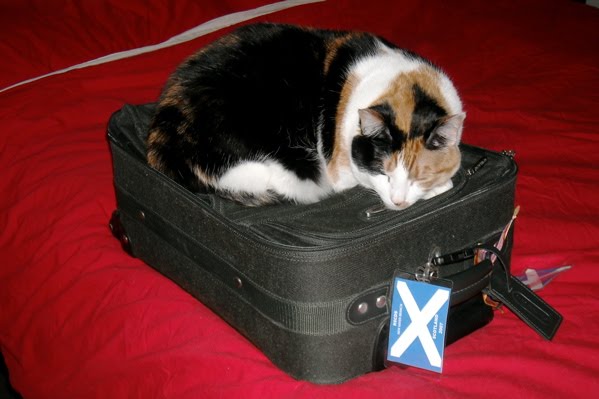
Photo credit: "Tally on My Suitcase" by Lucile Blanchard

"Cause an Uproar" video

Saturday, March 5, 2011


One with the Herd

A long-time feminist, the racehorse Zenyatta’s story grabbed my attention because her bodaceous, curvaceous self has held her own in a field dominated for centuries by finely bred and trained males. She is one joyously powerful female! I hope you saw her magnificent gallop-in-from-the-back of the pack loss-by-a-whisker in the last Kentucky Derby. Not usually a racing fan, I was on the edge of my chair! You can see her win the Breeder’s Cup in this cliphttp://www.youtube.com/watch?v=xoyYGjCTQGk

Of course I’m not alone in thinking horses are divine creations. They are lifted up in the Koran: “When God created the horse, he said to the magnificent creature: I have made thee as no other. All the treasures of the earth shall lie between thy eyes. Thou shalt cast thy enemies between thy hooves, but thou shalt carry my friends upon they back. Thy saddle shall be the seat of prayers to me. And thou fly without any wings, and conquer without any sword.”

I can see the saddle as a place of a sacred communing. As my aunt, a long-time horse trainer, rider, and teacher put it: “Caring for horses and connecting with them as partners also connects us to the land and the larger world. It’s never just the person and the horse, it’s always the person, the horse and the environment that they are part of. They invite us into their world as accept us as part of their herd,with a (mostly) joyful, willing spirit.”

So I was greatly saddened when I read recently about horses being used to run drugs and then abandoned in the Southwest, and about horses being released into fields north of Dublin during this Great Recession. Because they are expensive to keep, horses have long been given up by those facing hard times. But to release them in the desert, or in a wintery no-man’s land is hard to understand.

Without decent food and water, these animals quickly weaken. From a March third copy of The Portlander, out of Oregon, we see some of the possible results of such abuse: “Additional tests show that all of the horses are in depressed states suffering from severe malnutrition. Veterinary exams also found that they horses suffered from hoof abscesses, rain rot, ear mites, skin sores, gingival abscesses and severe dehydration. They also displayed flaccid muscles that could barely hold their weight and swollen limbs from infection and lack of appropriate nutrition.”http://theportlander.com/2011/01/05/abused-horses-rescued-in-woodburn/

My source in Ireland tells me that – between the weather and the economy- this was a very harsh winter, and a horse can now be got for a cell phone. People buy them cheap in markets in Dublin, race them, and then abandon them again. (See www.ispca.ie. ) In a country that has long revered the beauty and intelligence of these animals, it’s shocking to see them abused.

These recent tragedies overlie too many cases of abandonment and abuse already happening around the world. If we sincerely cherish this web of life, we can all help by teaching children –early and often- compassion for all animals. We can help others understand what we take on when we take responsibility for our fellow creatures.

Bringing her love of horses wherever she goes, my aunt puts it this way: “Caring for the horses – in Hawaiian, that’s malama ka lio – means, of course, providing sufficient feed, water, shelter, sufficient space, companionship, a healthy environment. Ideally, it also means helping them learn to relax and trust us, their partners in the horse-human relationship.

Building trust between species is a vital step in insuring our mutual survival on our jewel of a planet.

***********************

Photo: Sarah Blanchard and friends on a trail ride in Hawaii.

Lots of places, luckily, do minister to abandoned and abused animals, including the Irish S.P.C.A. mentioned above. Here’s a small sampling:

http://support.mspca.org/site/PageServer?pagename=acac_Nevins_AboutEquineandFarmACAC

http://www.freshstarthorserescue.org/category/blog/

http://www.azequinerescue.org/Rescue_help.html

http://support.mspca.org/site/PageServer?

Saturday, February 26, 2011


San Diego Zoo, Fall 2010

Photo credit: Carter Blanchard


New Noahs

Those of us who can- literally- afford to struggle with ancient questions about our relationship to our fellow animals. - questions older than history. Some answers have been painted on cave walls, found in graves, written in ancient texts, and handed down in stories. In the Jewish Torah, we find in Genesis accounts of our mutual creation and, later, of our mutual salvation, thanks to Mr. and Mrs. Noah. So grateful and charmed by the pairs of species saved, we rarely stop to think about the myriad lost in the great flood.

Today we face various devastating changes to our environment, and the question is who will survive and how. Zoos were originally build for the amusement of the rich, but they may be our modern arks.

As I child, I found zoos exciting, but also creepy. They used to be built like maximum security prisons, with cement floors, steel walls, and layers of bars and fences. Walking through a lacy, treed aviary –a stories-high outdoor sanctuary full of Seuss-like birds – was the exception. As a child I felt excited feeding peanuts to our zoo's four elephants, but discomfitted by the chains around their ankles anchoring them to a cement slab. The more experience I had with animals, the more I grew to hate zoos.

My boycott lasted only a decade. My excuse was that I wanted my children to see in flesh, feather and scale, to experience other sentient beings and come to admire, if not love, them. But it’s me who can't walk away from the experience of entering another's life, from sensing a different kind of intelligence, seeing the world as similar and yet radically different from the one I inhabited.

Recently I found myself drawn to the zoo again, taking advantage of courses offered through the local adult education program for classes and tours. After learning about big cats, one of their keeper's - a petite brunette- took us behind the scenes to meet the two tigers and very senior lion. I was surprised at all the training that goes on, coaching the animals to come to the fence for shots, and to stand on a scale to be weighed, as well as tricks. The cagey old lion has learned to use a wall to make himself sound younger and bigger. Check out his bona fides here: http://www.youtube.com/watch?v=YmzKQKl3Gjw

We learned that, at eighteen he’s eight years older than a lion in the wild would be, and his mane is full and well-groomed, where a wild adult lion’s mane would be worn and mangy. After another class - on lowland gorillas - I got to spend an hour and a half watching the resident tribe of eight. Guarding a four day old baby from her curious father and two eager sisters, the mother snatched a few minutes rest before foraging for snacks the keepers tossed in various places for them to find. Any mother could relate!

It’s lucky that I went back, because, as Paul Simon sings, “It’s all happening at the zoo.” By visiting most zoos today we support modern arks, spaces nurturing and stimulating to many species, some of which are threatened with extinction in the wild. A number of the animals in today’s zoos have been rescued from private attempts to keep wild animals and from aging out of circuses. Today’s zoos share resources, knowledge and stewardship of the gene pools of species in captivity.

Noah would be jealous of today’s zoo keepers, who are much better equipped to keep their charges healthy, both emotionally and physically. Of course we’d rather the animals were free and able to live their wild lives out in their homelands - and it's tragic that they're so threatened. Fortunately zoos provide us with a way to observe and appreciate other ways of being, learn what we can do to protect all the homelands, and wonder anew at the variety and beauty of Creation. Zoos may be one way we can serve as Noahs.

* * * * * * * * *

To find out more or peek at animals doing their thing via webcams, please check out these sites as well as your local zoo: http://www.zoonewengland.org/Page.aspx?pid=219, http://www.rogerwilliamsparkzoo.org/, http://www.sandiegozoo.org/

To learn more about a pioneer zoo director and get a behind the scenes look at the challenges of zookeeping, look for "My Life in a Man Made Jungle," by Belle J. Benchly.


Thursday, February 17, 2011

Meanwhile, Back at the S.P.C.A.

Compared to most other animals, rabbits have the neatest poop ever. That’s one thing I was grateful for this morning as I cleaned cages in the Small Animal part of our local animal adoption center. I was also enjoying how quiet rabbits are until Houdini, a white furred, pink eyed, good sized, Easter-style rabbit huffed at me. Hufff hufff huff!

Here am I, Bunny Goddess, about to bestow fresh bedding and alfalfa pellets, and he has the nerve to get all huffy at me. But I gave him some space and hurried up with the food, so he got quiet again and munchy. I tried to remember if any divinities were ever so humbled by those they patronized in the old stories.

Later in the morning, I took on a new job helping with a show and tell and story program for young children. We set up coloring stations and put on music, placed quilts on the floor for the story time, and greeted our guests. They were so young that they were mostly pre-verbal, but bright-eyed and pink cheeked. Today’s animals were conures, small parrots with large black eyes, green and blue bodies, red tails and almost iridescent, sturdy beaks. We put a little fence around the cage against the curiosity of little fingers.

Encouraged not to expect too much from such little ones, I noticed that some wandered off or sat down to coloring. Before long children and adults surrounded the cage where One, Two, Three, Four and Five were perched like a line of clones. Five pairs of birds'eyes followed us. Our leader pointed out the special features of birds – wings, feathers, beaks – and a few children flapped their arms and grinned. They got it, the sameness and the difference of these jewel bright animals.

As the room filled up with toddlers, infants, and adults, the birds suddenly relaxed and moved to the bars, the swing, the seed cups, whistling and calling out – to each other and to us. Suddenly we weren’t people staring here and birds frozen in fear there, but two communities appreciating one another, talking and connecting in ways you could barely see but could feel. The room got noisier and noisier and the leader clapped her hands so the people knew to settle in for a story. And the five green birds, they grew quiet, too, and stayed that way until the story’s end.

Being with animals often reminds me of my perch in the grand schematic, which is good for the ego and lifts the spirit, kind of like wings.

Thursday, February 10, 2011

Early One Morning


The long stare. Designed on purpose to make you feel like prey, the long stare is what they call the look some canines give to, well, their prey. Grabbed by that stunning stare, my friend and I were mesmerized. What was that animal? A large German shepherd? Too tall and healthy looking to be a coyote. Maybe a wolf? No, not in New England. No any more.

Most probably it was an eastern coyote, which can have a little dog or wolf mixed in. Canis latrans (barking dog, its scientific name) is one wild animal we have in common. Clever, elusive, and adaptable, coyotes range throughout most of North America to slightly south of Mexico. As our local predators literally lose ground, coyotes move into the vacuum, even in urban areas. How do they manage to thrive in so many places? They’re opportunistic, hunting day or night, and easily evading us, one of their few predators.

Today most of us live in range of a coyote, which means coyotes hunt, mate, and whelp in our neighborhoods. (Over 10,000 live in Massachusetts alone.) Some of us like this idea, some of us are rightly nervous for our pets or even our young children, and some of us want them dead. While it makes sense to be aware of their untamable nature, fear too often leads to panic and violence against them.

It also makes sense to think about things from the coyote’s point of view. Small animals equal food, garbage cans contain food, and so our landscape becomes hunting grounds. Some people feed coyotes, in effect training them to think people = food, which is rarely a good idea. (But then seed producers have started to market squirrel food which, if you’ve ever tried to get squirrels out of your attic, you know is super unsmart.)

Like many of you, I live in a place where wild, domestic and human animals share space. We build porches and skunks build their dens under them. We feed birds and squirrels come running. We let our cats out and coyotes seeking food for their young come hunting.

Yes, coyotes are killers. Just like us, they’ve got to eat. And they’re also parents, faithful partners, and helpful pack members. They eat mostly rodents, the kind that can become pests, like mice and rats. They sing and howl, bark and huff, like we do. Indians had such great respect for the coyotle that they made him a star trickster and a deity in their stories.

I was relieved to find my town is smart about these neighbors. Animal Control has a very useful coyote page that shows where they’ve been seen and how they’ve been behaving. The deep snow we have means they’re spotted more often, but they’re being very good given how hard the hunting must be. The story this site tells is that we're being good, too. We're being sensible about our pets and other things, like pet food, that might entice them to come closer to humans than is wise.

A world without wild is an empty world. We’re all safer – wild and tamer-- if we respect one another, letting each species do what it needs to do to survive with a minimum of conflict.