Writer Anatole France is often quoted as saying that “Until one has loved an animal a part of one's soul remains unawakened.” In these pages I hope to affirm your love of animals - or promote a love of our fellow animals - through reflecting on the many ways animals help wake our souls.
Friday, March 9, 2012
We've moved!
Tuesday, February 14, 2012
Love Overflowing

There’s probably no need to preach to this choir about the power, the healing, and the grace bestowed by love – we in this virtual room have enough love pouring forth to welcome even other species into our households, sharing our food, our time and even – some of us- our beds- with cats and dogs, birds, mice, lizards, turtles, rats, and so on. We do our level best to keep them from harm, to feed them nutritiously, amuse them, provide medical care and even occasionally clothe them. We love our animals.
We do our very best to love, often going that extra mile for a new toy or the expensive dental cleaning. But in this, the month dedicated to the muddy and transcendent work of love, the Islamic mystic and poet Hafiz challenges us – yes, even us- to “Make a new water-mark on your excitement/ And love.” (from The Subject Tonight is Love - versions of Hafiz by Daniel Landinsky)
In the setting of campfires and mending, a flowers scent and a hillside, he tells us to abandon our sense of Self to the point of flooding ourselves with passionate involvement with life and to let love fill us so that it pours over the banks of our ego. This flood of selflessness carries our egos along with it- it spills out into the world raising high new marks on the walls of our existence.
This is a frightening invitation, but it’s one I believe that our engagement with our fellow animals opens us to. If we can open our hearts to another being, we can welcome, forgive, be merciful and love all beings.
I want to share with you two stories about love that I think illustrate the radical nature of what Hafiz says so beautifully:
The first is a story that we are all probably familiar with: the recent terrible slaughter of 49 exotic animals released by their owner Terry Thompson who, in a fit of revenge that spilled into madness, let them out of their cages - . “Among the animals killed were 18 Bengal tigers, 17 lions, six black bears, one baboon, two grizzly bears, three mountain lions and two wolves.” Six that were unharmed were taken to zoos.
What we may not have considered is how Thompson and his wife started down this path: they began with what at the time looked and felt like love – a love of wild animals. Perhaps they began with one – interested and committed to caring for it as best they could. They had the space, so they acquired more of them, convinced that they were doing a good job and the animals were better off with them than in the unpredictable and dangerous environments they came from.
And then what may have started off as genuine caring grew into something we now know is a form of hoarding – collecting for the sake of having, stoking an ego that loved the idea of love, not the actual ego-less love that is life giving. The couple’s marriage fell apart; they did not keep up with the feeding and care of the animals. Even one leopard which was saved had to be euthanized the other day because it couldn’t survive an accident with the cage door – an accident it might have lived through is it hadn’t been weakened in bone and body by years of malnourishment.
So what does the love that overflows the narrow banks of ego, raising our engagement with the world to new heights, look and feel like?
Let’s look at the life of Louis J. Camuti (August 30, 1893 – February 24, 1981). According to Wikipedia, he “was a New York City cat veterinarian who made house calls for over sixty years. He was the first veterinarian in the United States to devote his entire practice to cats. His autobiography, ‘All My Patients Are Under the Bed: Memoirs of a Cat Doctor.’
He once told an interviewer that when he was 11 and ill with typhoid, a fire had broken out in his home and his cat hopped on his chest and breathed in his face. Too weak to leave the bed, he interpreted the cat’s behavior as follows: ‘As if to clear away the smoke and protect me from the fire,’ he said, ‘the cat stayed on my chest until my mother rushed into my room.’ "
Here is a life in which passion and love overflowed – he dedicated his life – and we’re talking weekends and nights of leaving the dinner table, leaving the kids’ stories unread, etc. -to the animals he cared so deeply about that his own comfort was secondary. Don’t get me wrong- we’re not talking about martyrdom here, and neither was Hafiz. No, the opposite; we’re talking about a heart so opened by love that commitment and joy became one. How do we know? Because he practiced well into his 80s. He set a high watermark for us all.
May we too be flooded with the All Powerful Mystery which is Love.
Monday, January 23, 2012
5 Tips for Happy Animal Companionship
Cute, aren’t they? So soft, friendly, and adorable. They, along with three brothers-sisters were left at the surrender desk of our local SPCA recently. Oh, and their mother. Why, you might well ask. Good question...and there are myriad answers to why people get rid of their pets. In my volunteer work at a local shelter I’ve learned there are some vital things to think over about before bringing a fellow animal into our homes.
But the loss, the confusion, and the sadness for all involved can be avoided by our asking some key questions before we buy or adopt a fellow animal.
1.) Everyone in the household should be willing. Everyone, including other animals. When we bring a new being into our homes, we invite new intimacies and compromise – it makes sense that everyone needs to be willing to enter into both.
2.) Falling in love is grand, but true, fair and enduring love includes a practical assessment: can we afford food, medical and dental care, shelter, and the occasional fun date?
3.) Are we just crushing, or are we loving “till death do us part?” Most animal companions will age and die before we will: are we emotionally and financially prepared to do our very best throughout the life of our friend? If we take on an longer-lived animal companion, have we made provisions for its care should something happen to us? I once heard of a person whose provision for a parrot (They can live up to 80 years.) was euthanasia!
4.) Most of us wouldn’t bring a complete stranger into our homes, but a surprising number of people bring animals we know almost nothing about into our lives and expect magic to happen. Animals are complex beings and they can't speak, so why do we rely on magic to create a relationship? Learn all you can about your prospective roommate (or its breed- genetics count!) before you seal the deal: gender, family, medical history, appetites, habits- good and bad, likes and dislikes, food needs and preferences. If it’s a species you’re not familiar with, talk with experienced others early and often; clubs and on-line chats are great and easily accessible resources. Listen hard and don’t think your experience will be exceptional. “Exceptional” means “very rare.”
5.) Loving another means being responsible to and for that being: be sure to spay/neuter, do all needed training, and commit to providing emotional and intellectual stimulus so that you and your animal can enjoy a rich, full life together.
Like the songs say, lovin' ain't easy, but being abandoned or having to abandon is much, much worse. Enter love with a full and intentional heart, and you’ll be richly rewarded.
Tuesday, January 17, 2012
Resolution: What’s your audio quality?

On January 2 I Googled "resolution" trying to figure out if I should make one or not. One of the top definitions was "audio quality." Combined with a wonderful Havel poem I'd just read, talking about being able to hear "the Voice of Being," I woke up, in a Zen kind of way.
How’s your audio quality today, at the turning of the year? Is our direction forward clear and hopeful, or are we receiving only static, distracted by loss and pain?
Are we feeling, “Boy, this could be the beginning of a great adventure of the soul!” or “I despair of ever finding my way, grounding my life in meaning again.”
In a group of soulmates, we may find ourselves in good company for getting better resolution: maybe gather the willpower to listen harder to the soft voice within. It's important because the power to listen more intently means being more responsive and responsible in our relationships. And this can be an especial challenge in inter-species friendships.
Resolutions are a mixed bag: we don’t want or need the guilt, the sense of failure, that comes with failing them. I avoided making resolutions for years thinking I didn't need this kind of baggage, but a few years ago I began to think of resolutions differently: I began to think of them as I do prayer – as putting my own Voice of Being out there as intention. And I noticed others are thinking along these lines – a Twitterer posed it this way: What is your intention for the new year?
Each one of us plays a part in sending and receiving the Voice of Being. It may be the most important thing we do to keep our relationships vital and healthy. Being moral beings means we have a responsibility to listen with all that we have to one another. This isn’t easy- it takes a spiritual practice or moral discipline, or whatever you want to call it.
I know I haven’t been listening with all my being lately, with worrisome effects on my loved ones:
For instance, I recently took my dog to the vet for her annual check-up and learned that I had been lazy: I stopped using her tick repellent too early this fall, so she now has Lyme disease. And because I didn’t pay enough attention to how much I was snacking her as the weather got lousy, she’s gained a bit too much weight. (She's now on amoxycillin and a diet, and doing well.)
Even people of good will and good faith can forget is that not listening all out, our antenna quivering, prevents us from being atuned, one-tuned, singing the same song.
One more story about listening: the author Elisabeth Tova Bailey (fell very ill with a mysterious and severely debilitating virus and could only hear the voice of despondence and despair. She was given a gift – a friend found a snail and brought it, along with a little of its woodland terrain, to her to amuse her as she was incapable of doing much but lie still. She watched this small mollusk day in and day out; she saw a creature whose life and limits were even narrower than hers – and this gave her perspective and hope. Witness to the life of the humblest of beings, to the dignity and integrity with which it went about its days, then becoming involved in caring for it and its family, she gained greater compassion and less self-pity.
So for the year ahead I hope you will join me in a rededication to living with high fidelity, to being more responsive and responsible in our actions- to continue to grow our hearts. I know I’m not the first or only one to become a bit deaf to the symphony that is life– and I’m very grateful for my communities, which help center me in what matters, which help me better hear the laughter and the tears of the cosmos. Happy New Year!
Tuesday, August 9, 2011
Mother Maya Says
I have a ton of questions about these otters caught hanging out - and I have none at all. Their holding hands just makes sense, you know?
Two days ago I ran across an actual note to self: “Mother Maya says, “What are your questions?” Intrigued as to why I’d copied this enigmatic remark, I put it in a new pile. But her question wouldn't let me go.
As I talked with lots of people and met lots of other animals, I thought about the questions we were all asking, or repressing: the chestnut mare obsessed with a patch of clover; the greyhound, lamed by being raced; the seven parakeets left homeless along with their owner; and the happy cocker spaniel that greeted us at the park this morning. What questions apply to our shared lives? What questions were we human caretakers asking and which were we avoiding?
I came up with a few. My first caution, dear reader, is that they are not easy ones. The second caution is that my answers are works in progress – as your own might be. But these questions did lead me back to something important, and I hope you’ll be encouraged to ask your own.
First, what does it mean to “own” another being? Increasingly, as Adam Gopnick so beautifully explored in a recent New Yorker article about becoming a dog owner, there’s clearly more than “ownership” in play for many of us who share our lives with other animals. But not for all of us. What’s our moral obligation when we take on this responsibility? Do we adequately prepare, financially and in other ways, for a rich and happy life and for the old age of our pets?
Is there such a thing as a “good death,” and if so, what does it look like?
Few beings, I believe, want to die, so in that sense I’d say no to the first part of the question. But I also know that when a being begins dying he or she starts a journey that only they can take. Death’s essence is aloneness – which is hard and haunting, especially for the survivors. On the other hand, when my father was deep inside a coma, he knew we were present and could hear us because he told us when he recovered. So I believe that even in a dying state, the presence of others is known and can be comforting.
For me, as for many beings, a good death is a natural and peaceful one, with little or no pain, in the presence of those I love. A good death also means making time to express your love, to remember, and to hold on to one another.
Another aspect of a good death is the opportunity to come in our wholeness to this new experience. Asking for forgiveness, speaking our love and our care, sharing happy memories, sacred times, and letting go of regret – these acts bring wholeness to any relationship. I want to come to death, mine or a beloved’s, filled with loving-kindness: scars, warts and all, but one.
It turns out that Mother Maya is an extraordinary woman who recovered from ovarian cancer to become a healer of body, mind and spirit. She speaks all over the world about the need for spiritually grounded healing practices in order to remove pain and suffering from the world – the earth and all beings. What does she say about healing ? “It's about knowing that each and every being must be helped into wholeness. Only then can we become whole in ourselves.”
Our purpose in life is to bring about wholeness of all beings. That’s a purpose to ponder – to enable the full “beingness” of others. And that is how I answer my last question, which is, “Why are we here?”
Mother Maya’s question about questions is important when we think about the other beings we bring into our lives. We bring wholeness to them through our bringing non-violent, life-affirming intentions to our treatment of all beings, and we live into our own wholeness this way.
Sunday, July 31, 2011
May We Be a Source of Happiness

I’m having trouble settling into writing because I miss my pal – Maisie’s usually curled up next to me as I write. She’s fine, just elsewhere at the moment, leaving me surprised at my sense of loss.
Which is ironic, because I’ve spent this past week sharing stories of actual loss of animal companions with people. People who’ve lost pets, of course, but also dog walkers, kennel owners, and vet techs – people who treat and care for animals and come to know them – they mourn, too, and can mourn hard. When we get to know another being, bonds form, bonds beyond language and our ordinary understanding.
There’s another, darker side to the story, too. At the SPCA last week, the surprise animal for the toddlers we host for “Little Bookworms” each week was an eight week puppy named Bounce: this beautiful, affectionate female had fallen from a balcony, and been left on the pavement until neighbors found her and brought her to the rescue center. It’s hard to imagine someone allowing such a thing to happen, but, sadly, the folks at the SPCA see this kind of thing all too often.
So today I’m in a prayerful mood, prayer as a way to witness and to center my spirit on what is good and true so these realities can light the way when lost or in despair.
Spirit of Life, hear my deepest wish: may I care for the well-being of others, may my mistakes and thoughtlessness be forgiven, may my life be a blessing to others, and may I give thanks each day for all the blessings others give to me.
Spirit of love, may my heart lead, my mind prevail and my hands reach out to bring about a more beautiful and just world for all who share it.
Give me the strength to know what I may change, the courage to face what can’t be altered, and the wisdom to know which is which.
Thank you for the companionship of all who dwell beside me. May I be a worthy companion to them.
Blessed be. May it be so.
Wednesday, July 13, 2011
Practicing Wholeness

Ah, summer fun out doors – carefree and easy times. Maybe our iguana gets to rule the screened in porch, or the cockatiel or conure perches there in the sun. These are the days we remember when the cold and wild winds blow, or the rough times shadow us. My dog and I just enjoyed an evening soccer scrum with her favorite big blue ball. I curd an evening romping romp with her favorite big blue rough times shadow us. t our time outside short, though, because it’s hot and she’d eaten just an hour ago and I recently learned about bloat.
Bloat’s not good, not at all, and if you don’t know about it, please look it up now – there’s lots of helpful and practical material out there that may save your animal’s life.
We can avoid or prevent many things from happening to those we love, but not everything, by any means. Sometimes, when bad things happen, we have no choices – we have to accept events as they’ve unfolded. There are also times when knowing your pet and having some resources can offer you options. Friends of mine have a small dog who, as a puppy, raced out an open door and onto the street. He was hit by a car and badly hurt. My friends took a chance, had some resources, and today their beloved dog races around on three legs, loving life.
Sometimes, even when it comes to the end of a life, we may have choices. I value hospice care because it’s one such choice for some people and their loved one when faced with a terminal illness. Recognizing that we can establish deep bonds with other animals, today hospice care is increasingly available for them as well as well as humans.
Hospice care modeled on the best of human hospice offers pain relief above all else- but doesn’t stop at the physical pain. Hospice care includes emotional support and spiritual care. For animal caregivers, spiritual care acknowledges the great rewards in walking the whole journey of life with your companion, and also that there are challenges on such a path.
As your companion’s primary caregiver, you’ll make vital decisions while tending to the physical and emotional needs of your pet. In addition, you may have to manage the needs and concerns of other loved ones – family and friends. Renewing your own spirit will enhance this precious time and insure that you are able to give the best care possible.
Finding a sustainable spiritual practice now will help you feel more confident that you are making the best choices, when you have them, and accepting life in all its fullness, sadness alongside joy, when you do not.
For my practice, I just started a gratitude journal. I decided I could make time to write - at the start or end of every day- at least three things I’m thankful for. It’s been a surprise to find the list grow longer at every session, and in the process to let go of the inconsequential parts of my day. It’s like a shower for the soul.
Anyone have a practice that helps you stay centered and renew your sense of purpose? Dancing, meditating, prayer beads, or a special piece of music? Please feel free to share what works for you in the comment box below.
Friday, May 13, 2011
New England Pet Hospice is on the Runway

A few days ago I drove out to Bolton – beautiful apple country- to meet with Heather Merrill, the founder of the New England Pet Hospice. Dressed in my Pet Hospice uni of a maroon shirt and khaki pants, we shared our enthusiasms and our ideas over coffee, then set out for the Integrative Animal Health Center, where veterinarian Dr. Randy Caviness and his team welcomed us.
I knew we were in an interesting place when I pulled into the drive, and a Buddha statue sat across from the entrance. Inside there were images from Taoism and beautiful photos of animals, along with a Tang-style statue of a horse. Dr. Randy and his team treat animals holistically and we were there to tell them how the pet hospice services would complement and support their work with animals and their caregivers.
Heather led off by talking about the many ways members of the hospice team help with respite care, nursing care, transportation, housekeeping and emotional support for the family. She stressed how her vision of animal hospice care is modeled carefully on human hospice care. I talked about grief support, creating memorial and funeral services, and also about support around euthanasia when that seems to be the best course. When I talked about supporting vet staff as well, the comments were very positive. Most people trained in medicine are compassionate, caring folks, but often don't have the time or the expertise to offer as much emotional or spiritual support as might be needed.
Heather and I, in full launch mode, appreciated the careful listening and the helpful feedback we were given.
Just today I found out that we’ll be dedicating a beautiful memorial garden for pets in Sudbury this summer. All of these options affirm my belief in the depth of the relationships that develop between species, and that honoring them is important for all beings.
Stay tuned for two opportunities to have your pets blessed: open to all, it will be held on October 2 at the First Parish in Brookline at 3pm, and another opportunity in the fall will be in Sudbury, the date and time TBA.
Saturday, May 7, 2011
My Big Oops

Yesterday morning I felt awful because I had forgotten to follow through on a pet sit for my dog Maisie and I had to attend a six hour meeting starting in the late afternoon. Maisie, a five year old Morkie, part Yorkie, part Maltese, is so patient when I work, and I’m a bad pet owner, and here it was National Pet Week! Long story short, I scrambled and came up empty...what to do?
I didn't like to leave Maisie home alone for that long, and I couldn’t take her to the interviews I was overseeing, though she might have been a great ice breaker. I decided I would take her the work, where she often sleeps very comfortably in my office, and visit her during the breaks. It wasn’t ideal, but off we went.
We took a walk before the meeting, enjoying being outside on one of those spring afternoons where you can hear the maple leaves growing, smell the earthworms doing their thing in the dirt, and watch all the tulips dancing with the daffodils. Perfect. Maisie did her business and I cleared my head enough to notice something I’d left off the interview agenda.
Of course I gave Maisie a Kong toy to play with and to ease my conscience. But the best thing that happened was that a fellow interviewer’s teen found my office a good place to spend some time, and he was great with Maisie. He took her on the all-important post-dinner walk, and she kept him company while he played computer games.
And after the meeting was over they both joined us, both happy to get on with whatever came next, helping us make the transition from tough choices to home.
While it wasn’t smart to wait so late to plan for my pet’s care, and I’m lucky I can take my pet to the office, my mistake led to some insights, some deeper connections, and a tail wagging ending to a long day.
So hats off to pets and to their mostly responsible caregivers – being present to and understanding of one another's needs is how we make ourselves worthy of the company we keep!
Sunday, April 17, 2011
Honk if You Like Spring

Not until the end of this past week was I able to come up for air and relax outside. With the dog, of course. Maisie and I took one of our longer walks down to the river, where it meanders under bridges and roadways, with plenty of green space and paths alongside for bikers, runners and walkers. A few miniature islands and peninsulas add visual perks for us and cool perches and nesting spots for birds.
My week had buzzed, so I sought peace and quiet – and how Mother Nature belly laughed! She used the Canada geese. They’re courting and nesting now, and stake out real estate on these little bars and banks with which to convince their lady loves that they’re husband material.
One little island had five Canada geese on it, their long black necks sticking up from the brush like periscopes. Even I could tell that this was two geese too many. From the center of it all one goose lowered his head like a half-back, his shoulders spread and braced for the impact and charged, honking like an air raid siren. Mr. Encroacher ducked and charged and honked likewise and they kind of pushed each other. The center island goose prevailed and, by chasing the other out into the water, created a DMZ.
Meanwhile, another incursion was met and rebuffed on the opposite side of the little patch of dirt and brush. Lots more honks from cheerleaders in the water. 0ur walk was punctuated by the trumpeting and the chirruping of birds of all kinds.
Like Macbeth’s witches, three cormorants huddled on some limbs overlooking the water, and having adjusted their black capes, remained silent.
Spring had another surprise – well, not really a surprise, but a reminder. Maisie was wandering around, sniffing what appeared to be amazing sniffs, and failed to see a small silvery dog approach, clearly very lame but poking around as best it could. His owner was nearby, watching. Tobey, a poodley mix, was recovering from a recent stroke and this was one of his first forays out; she reveled that he was doing, motivated perhaps by those self-same smells as held Maisie in thrall.
Julie, we’ll call the owner, shared that Tobey was about 12 or 13 when she’d adopted him, a senior rescue. She’d had him for three years when the stroke left part of his left side paralyzed. Other than the bum left leg, I only noticed a little droopiness on the left side of his mouth, but I didn’t have time to ask if that affected his eating – she was concerned to get Tobey back to the stroller she’d brought along before he used up all his strength.
As Maisie and I continued our circuit I thought about the love of life and the will to stay part of it, smells, honks, crazy mating games and all. I thought about my mom’s recent fall and recovery, her will to get back to the business of living, going where she wants to when she wants to. And I thought about Tobey, at age 16, at least as eager to get his nose into the dirt as my mother is to get close to the sweet earth of her garden. In spite of the pain, the awkwardness, and the inevitable tiredness.
Yes, I thought as I left the park, spring honks and sniffs and twitters with living, and what wonderful music that is.
Saturday, April 9, 2011
Get Your Crush On

But I’m learning about pets: animals, clean and calm and caged are like those gorgeous displays of multiple t-shirts in luscious colors. You buy one and get home and – ho-hum. One shirt, pretty, but not the effect that tickled your happy while doing retail therapy.
I think of those pretty shirts especially when I see ferrets curled in a puppy pile – adorable, snuggly – about to whirl into fun mode. You bring one home and it’s the two of you, BUT... you can’t lie curled in the fetal position all day, or toss a little ball into the night. You’re bored and the animal you love is bored, and then there’s guilt setting in. But two means twice the expense and they go a bit feral if you don’t interact with them for stretches, so guilt AND anxiety set in.
Some days the world seems divided into two groups: people who like animals and people who don’t, particularly. This is really simplistic, of course, because we fall along a broad spectrum of connection, we with myriad other animals.
What I have noticed is that as our numbers grow and grow, while the numbers of other species dwindle we seem increasingly to want to have animals close by. (Extreme animal stories abound: pet lions, tigers, and pythons- until, that is, they start behaving like animals.) But I’m talking about regular pets and long-term loving them, and how we have to get smarter about our crushes.
Our pets’ lifespans mostly are shorter than ours, so if we really love them, we take into account their training period, their reproductive lives, and their geriatric needs. To be a true animal lover, I’ve come to believe, means taking a “’til death do we part” vow. And having a plan that includes other options than euthanasia, if at all possible. (Take a close look at pet insurance plans, and also New England Pet Hospice for more information and support of your commitment.)
Loving other animals can provide spiritual deepening: humbling and heart-expanding, our pets connect us with the cosmos, its daily mysteries and endless questions. And it’s can be - should be- mutually rewarding: from us pets receive affection, care, and good health care – even dental! The richest rewards are developing understanding of one another in spite of differences in language, expression, and needs. The presence of another animal in our life is a gift for which we can show our gratitude in many ways – ‘til death parts us.
Tuesday, April 5, 2011
Just Wondering

We catch this kind of wonderful faster than a cold... and then there’s the old fashioned “What the heck was that!” kind of wonder: something falls out of the sky or swirls darkly across the face of the earth making us run for our lives.
Maybe you felt this kind of wonder on hearing about birds falling from the sky this past January. According to one local paper: “Dozens of lawns, streets and rooftops for more than a mile in Beebe, Ark., were covered with the corpses of red-winged black birds. An aerial survey showed that no other dead birds were found outside that area.”
Imagine that – a square mile of bird bodies! How tragic and how weird. In ancient days, angry prophets would have found this to be a sign of some human failing. Some of us, I know, wonder if it isn’t a sign of environmental degradation that’s eroding some animal species. Some of us were grossed out and flipped the channel. The scientific among us wondered if it might have been lightning or disease. And others of us just wondered at it – all those birds just dropping out of the sky- oh my, why?
What shocked me awake was that scientists responded without alarm: they reported that hundreds of thousands of birds die each year – and not only of human-made causes.
A vivid memory: one May in 1970, staying at my grandparents’ in Walpole, I was woken just before dawn by the stirrings and then a symphony of bird song – I’ve never before or since heard so loud, long, or various an orchestration. I was very awake then, sipping my “own cup of gladness,” as poet Mary Oliver put it in “A Wren from Carolina.” My introduction to the spring migration.
It was a true wonder, herald of nothing and everything – the gift of a new day. Every spring since I listen for that symphony: I hear the redwings in the wetlands, the thrushes and robins and myriad others - many just passing through, others settling in and down for the nesting season. I haven't heard such a glorious con gusto chorale since. Grace notes, we can call them, do surprise my spirit into joy and wonder.
Saturday, March 26, 2011
Rollin' Along

Like many of us on this blue and white marble of a planet I wonder lately what in the heck we’re doing. We’re allowing guns in crowded public places, including those that serve alcohol; we’re bombing another Muslim country; we’re worrying again about run-away radiation and the price of oil. Some days it feels like we’re hell-bent on ridding the planet of our wacky selves.
And then I hear sparrows having an early happy hour in the holly bushes outside, watch a teenage boy walking the family dog through the park, and kick a soccer-sized ball, to my dog, Maisie’s, barking delight. There’s still a place for sanity in this world, for petting cats, observing migrating birds rest in our parks, and enjoying the vernal evening choirs of peepers.
Connecting with the non-shooting, non-bombing species helps keep us sane, and if pets help us be centered and more at peace, then bless us for having them. But keeping animals has become another Humongous Industrial Complex – a $41 billion dollar a year business is no joke*. So today I want to give a shout-out to Petco. I just went there to stock up on food and toothpaste for guess-who and they have signs- big and frequent signs – encouraging patrons to adopt pets, which is so great!
Now I know they’re not being altruistic – pets have to eat, brush their teeth, and wear funny clothes wherever they’ve come from. I doubt that sales of hamsters and parakeets is where Petco makes its profits, but still... It’s an important reminder that a lot of animals are abandoned or surrendered by their owners and they need homes. So “Hooray!” for Petco for helping raise awareness of a real need – our local ASPCA will accept and hopefully find homes for 6,000 cats this year. Six thousand, just in this area alone!
So here’s another big “Hooray!” for the Societies for the Prevention of Cruelty to Animals and Humane Societies, that strive to put themselves out of business. I think that’s a very cool goal, to end cruelty to animals, don’t you?
Now if only human animals were seriously part of such a mission, what a wonderful world it would be.
*Interesting fact: the proposed U.S. military budget for 2012 is $553 billion, down $43 billion from this year’s request.
Tuesday, March 15, 2011
Forget Miss Kitty
Luckily I had a long drive home two Sundays ago, because our local public radio station interviewed Derek and Beverly Joubert who reported things that shook me out of my Pretty Kitty bubble– they film lions and have fallen in love with them. Which is tragic because within about fifteen years, unless things (ie. we the people) change a lot, we’ll inhabit a world without any. In other words, we will be the cause of their extinction somewhere in the neighborhood of 2026. I take that back – there might be a few still in zoos, but that too-small gene pool will peter out before long.
How is this happening? You know...planters poach their ranges, which cats need for hunting and for maintaining a healthy gene pool. And we have for centuries killed them in large numbers, chiefly for sport or for medicinal purposes (a bag of lion bones goes for big, big money in parts of Asia), and sometimes to protect livestock or human beings.
Did you know there are already more tigers in captivity than in the wild? I didn’t. All of the big predator cats, including leopards, cheetahs, and jaguars, are in danger. This reality seems so unstoppable and sad. Beyond sad –I feel that we’re on the verge of doing something that can’t be undone ever. Something that diminishes our lives and our planet’s being. Just knowing that such a beautiful creature as the lion roams the savannahs wakes us to wonder, to marvel at the delight and mystery of being alive. So if they are gone, we become less delighted, less enfolded in mystery and wonder- less alive.
I do appreciate that we have much to feel responsible for and sad about – the victims of earthquakes in so many countries, and the battles raging in too many countries, and the drought and famine that threaten so many. Human ingenuity and compassion could mitigate many disasters, but not one of our failures to do so threatens our own species to the degree that we have threatened others. That’s the problem, I think: our disregard for the survival of other animals, lives over which we now have near total control.
So what to do... I’ve been working on to making changes in how I live that I hope will lessen the pressure on those places wild animals need to survive. coffee, tea, beef, and oil are a few of the things I like to consume that take a huge hunk out of their habitat. I try to consume less, and pay a fairer price for more sustainably grown foods. I support only politicians who are for sustaining this delightful, mysterious world of ours.
It’s helped me to at least make a start. How about you? I’d like to know what your thoughts are about this issue. I’m looking for ways, corny, I admit it- to save what is left of the world we were born of and into, the world that has made us who we are, for better and for worse.
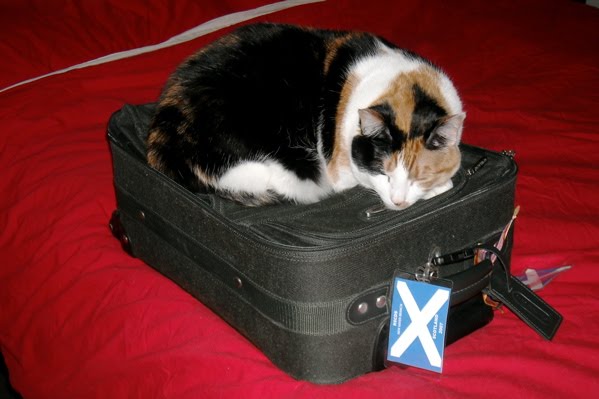
Photo credit: "Tally on My Suitcase" by Lucile Blanchard
Saturday, March 5, 2011

One with the Herd
A long-time feminist, the racehorse Zenyatta’s story grabbed my attention because her bodaceous, curvaceous self has held her own in a field dominated for centuries by finely bred and trained males. She is one joyously powerful female! I hope you saw her magnificent gallop-in-from-the-back of the pack loss-by-a-whisker in the last Kentucky Derby. Not usually a racing fan, I was on the edge of my chair! You can see her win the Breeder’s Cup in this cliphttp://www.youtube.com/watch?v=xoyYGjCTQGk
Of course I’m not alone in thinking horses are divine creations. They are lifted up in the Koran: “When God created the horse, he said to the magnificent creature: I have made thee as no other. All the treasures of the earth shall lie between thy eyes. Thou shalt cast thy enemies between thy hooves, but thou shalt carry my friends upon they back. Thy saddle shall be the seat of prayers to me. And thou fly without any wings, and conquer without any sword.”
I can see the saddle as a place of a sacred communing. As my aunt, a long-time horse trainer, rider, and teacher put it: “Caring for horses and connecting with them as partners also connects us to the land and the larger world. It’s never just the person and the horse, it’s always the person, the horse and the environment that they are part of. They invite us into their world as accept us as part of their herd,with a (mostly) joyful, willing spirit.”
So I was greatly saddened when I read recently about horses being used to run drugs and then abandoned in the Southwest, and about horses being released into fields north of Dublin during this Great Recession. Because they are expensive to keep, horses have long been given up by those facing hard times. But to release them in the desert, or in a wintery no-man’s land is hard to understand.
Without decent food and water, these animals quickly weaken. From a March third copy of The Portlander, out of Oregon, we see some of the possible results of such abuse: “Additional tests show that all of the horses are in depressed states suffering from severe malnutrition. Veterinary exams also found that they horses suffered from hoof abscesses, rain rot, ear mites, skin sores, gingival abscesses and severe dehydration. They also displayed flaccid muscles that could barely hold their weight and swollen limbs from infection and lack of appropriate nutrition.”http://theportlander.com/2011/01/05/abused-horses-rescued-in-woodburn/
My source in Ireland tells me that – between the weather and the economy- this was a very harsh winter, and a horse can now be got for a cell phone. People buy them cheap in markets in Dublin, race them, and then abandon them again. (See www.ispca.ie. ) In a country that has long revered the beauty and intelligence of these animals, it’s shocking to see them abused.
These recent tragedies overlie too many cases of abandonment and abuse already happening around the world. If we sincerely cherish this web of life, we can all help by teaching children –early and often- compassion for all animals. We can help others understand what we take on when we take responsibility for our fellow creatures.
Bringing her love of horses wherever she goes, my aunt puts it this way: “Caring for the horses – in Hawaiian, that’s malama ka lio – means, of course, providing sufficient feed, water, shelter, sufficient space, companionship, a healthy environment. Ideally, it also means helping them learn to relax and trust us, their partners in the horse-human relationship.”
Building trust between species is a vital step in insuring our mutual survival on our jewel of a planet.
***********************
Photo: Sarah Blanchard and friends on a trail ride in Hawaii.
Lots of places, luckily, do minister to abandoned and abused animals, including the Irish S.P.C.A. mentioned above. Here’s a small sampling:
http://support.mspca.org/site/PageServer?pagename=acac_Nevins_AboutEquineandFarmACAC
http://www.freshstarthorserescue.org/category/blog/
Saturday, February 26, 2011


San Diego Zoo, Fall 2010
Photo credit: Carter Blanchard
New Noahs
Those of us who can- literally- afford to struggle with ancient questions about our relationship to our fellow animals. - questions older than history. Some answers have been painted on cave walls, found in graves, written in ancient texts, and handed down in stories. In the Jewish Torah, we find in Genesis accounts of our mutual creation and, later, of our mutual salvation, thanks to Mr. and Mrs. Noah. So grateful and charmed by the pairs of species saved, we rarely stop to think about the myriad lost in the great flood.
Today we face various devastating changes to our environment, and the question is who will survive and how. Zoos were originally build for the amusement of the rich, but they may be our modern arks.
As I child, I found zoos exciting, but also creepy. They used to be built like maximum security prisons, with cement floors, steel walls, and layers of bars and fences. Walking through a lacy, treed aviary –a stories-high outdoor sanctuary full of Seuss-like birds – was the exception. As a child I felt excited feeding peanuts to our zoo's four elephants, but discomfitted by the chains around their ankles anchoring them to a cement slab. The more experience I had with animals, the more I grew to hate zoos.
My boycott lasted only a decade. My excuse was that I wanted my children to see in flesh, feather and scale, to experience other sentient beings and come to admire, if not love, them. But it’s me who can't walk away from the experience of entering another's life, from sensing a different kind of intelligence, seeing the world as similar and yet radically different from the one I inhabited.
Recently I found myself drawn to the zoo again, taking advantage of courses offered through the local adult education program for classes and tours. After learning about big cats, one of their keeper's - a petite brunette- took us behind the scenes to meet the two tigers and very senior lion. I was surprised at all the training that goes on, coaching the animals to come to the fence for shots, and to stand on a scale to be weighed, as well as tricks. The cagey old lion has learned to use a wall to make himself sound younger and bigger. Check out his bona fides here: http://www.youtube.com/watch?v=YmzKQKl3Gjw
We learned that, at eighteen he’s eight years older than a lion in the wild would be, and his mane is full and well-groomed, where a wild adult lion’s mane would be worn and mangy. After another class - on lowland gorillas - I got to spend an hour and a half watching the resident tribe of eight. Guarding a four day old baby from her curious father and two eager sisters, the mother snatched a few minutes rest before foraging for snacks the keepers tossed in various places for them to find. Any mother could relate!
It’s lucky that I went back, because, as Paul Simon sings, “It’s all happening at the zoo.” By visiting most zoos today we support modern arks, spaces nurturing and stimulating to many species, some of which are threatened with extinction in the wild. A number of the animals in today’s zoos have been rescued from private attempts to keep wild animals and from aging out of circuses. Today’s zoos share resources, knowledge and stewardship of the gene pools of species in captivity.
Noah would be jealous of today’s zoo keepers, who are much better equipped to keep their charges healthy, both emotionally and physically. Of course we’d rather the animals were free and able to live their wild lives out in their homelands - and it's tragic that they're so threatened. Fortunately zoos provide us with a way to observe and appreciate other ways of being, learn what we can do to protect all the homelands, and wonder anew at the variety and beauty of Creation. Zoos may be one way we can serve as Noahs.
* * * * * * * * *
To find out more or peek at animals doing their thing via webcams, please check out these sites as well as your local zoo: http://www.zoonewengland.org/Page.aspx?pid=219, http://www.rogerwilliamsparkzoo.org/, http://www.sandiegozoo.org/
To learn more about a pioneer zoo director and get a behind the scenes look at the challenges of zookeeping, look for "My Life in a Man Made Jungle," by Belle J. Benchly.
Thursday, February 17, 2011

Meanwhile, Back at the S.P.C.A.
Here am I, Bunny Goddess, about to bestow fresh bedding and alfalfa pellets, and he has the nerve to get all huffy at me. But I gave him some space and hurried up with the food, so he got quiet again and munchy. I tried to remember if any divinities were ever so humbled by those they patronized in the old stories.
Later in the morning, I took on a new job helping with a show and tell and story program for young children. We set up coloring stations and put on music, placed quilts on the floor for the story time, and greeted our guests. They were so young that they were mostly pre-verbal, but bright-eyed and pink cheeked. Today’s animals were conures, small parrots with large black eyes, green and blue bodies, red tails and almost iridescent, sturdy beaks. We put a little fence around the cage against the curiosity of little fingers.
Encouraged not to expect too much from such little ones, I noticed that some wandered off or sat down to coloring. Before long children and adults surrounded the cage where One, Two, Three, Four and Five were perched like a line of clones. Five pairs of birds'eyes followed us. Our leader pointed out the special features of birds – wings, feathers, beaks – and a few children flapped their arms and grinned. They got it, the sameness and the difference of these jewel bright animals.
As the room filled up with toddlers, infants, and adults, the birds suddenly relaxed and moved to the bars, the swing, the seed cups, whistling and calling out – to each other and to us. Suddenly we weren’t people staring here and birds frozen in fear there, but two communities appreciating one another, talking and connecting in ways you could barely see but could feel. The room got noisier and noisier and the leader clapped her hands so the people knew to settle in for a story. And the five green birds, they grew quiet, too, and stayed that way until the story’s end.
Being with animals often reminds me of my perch in the grand schematic, which is good for the ego and lifts the spirit, kind of like wings.
Thursday, February 10, 2011
Early One Morning

The long stare. Designed on purpose to make you feel like prey, the long stare is what they call the look some canines give to, well, their prey. Grabbed by that stunning stare, my friend and I were mesmerized. What was that animal? A large German shepherd? Too tall and healthy looking to be a coyote. Maybe a wolf? No, not in New England. No any more.
Most probably it was an eastern coyote, which can have a little dog or wolf mixed in. Canis latrans (barking dog, its scientific name) is one wild animal we have in common. Clever, elusive, and adaptable, coyotes range throughout most of North America to slightly south of Mexico. As our local predators literally lose ground, coyotes move into the vacuum, even in urban areas. How do they manage to thrive in so many places? They’re opportunistic, hunting day or night, and easily evading us, one of their few predators.
Today most of us live in range of a coyote, which means coyotes hunt, mate, and whelp in our neighborhoods. (Over 10,000 live in Massachusetts alone.) Some of us like this idea, some of us are rightly nervous for our pets or even our young children, and some of us want them dead. While it makes sense to be aware of their untamable nature, fear too often leads to panic and violence against them.
It also makes sense to think about things from the coyote’s point of view. Small animals equal food, garbage cans contain food, and so our landscape becomes hunting grounds. Some people feed coyotes, in effect training them to think people = food, which is rarely a good idea. (But then seed producers have started to market squirrel food which, if you’ve ever tried to get squirrels out of your attic, you know is super unsmart.)
Like many of you, I live in a place where wild, domestic and human animals share space. We build porches and skunks build their dens under them. We feed birds and squirrels come running. We let our cats out and coyotes seeking food for their young come hunting.
Yes, coyotes are killers. Just like us, they’ve got to eat. And they’re also parents, faithful partners, and helpful pack members. They eat mostly rodents, the kind that can become pests, like mice and rats. They sing and howl, bark and huff, like we do. Indians had such great respect for the coyotle that they made him a star trickster and a deity in their stories.
I was relieved to find my town is smart about these neighbors. Animal Control has a very useful coyote page that shows where they’ve been seen and how they’ve been behaving. The deep snow we have means they’re spotted more often, but they’re being very good given how hard the hunting must be. The story this site tells is that we're being good, too. We're being sensible about our pets and other things, like pet food, that might entice them to come closer to humans than is wise.
A world without wild is an empty world. We’re all safer – wild and tamer-- if we respect one another, letting each species do what it needs to do to survive with a minimum of conflict.
Tuesday, February 1, 2011
Make Way!
Welcome! This blog is about the interconnected web of life that weaves us together. Long known in India as the god Indra's jeweled net, this sparkling cradle holds all sentient beings.
Having lived in the country, the suburbs, the ex-urbs, and now the city, I've become an avid student of this fabric. Because there's less cover in the city, the threads of the web often stand out in relief. One melting morning in this very snowy winter I rounded a corner with my dog to find a mallard in the middle of the street delicately drinking water from an icy puddle. He looked healthy, but didn't move away when he saw us, so I tied up my dog and went to check more closely for injuries and get him to a safer spot if needed.